


Clean Label 2.0: The Industrial Race to Replace Methylcellulose
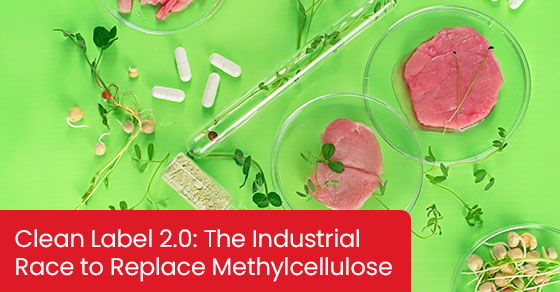
For the better part of a decade, the plant-based meat revolution relied on a “silent partner” to achieve the impossible. That partner was Methylcellulose (E461). As a chemically modified cellulose derivative, it possessed a unique property essential to food engineering: thermal gelation. Unlike most gelling agents that firm up when cooled (like gelatin), methylcellulose firms up when heated and melts when cooled. For a plant-based burger, this meant it stayed firm on a hot grill but provided a juicy “mouthfeel” upon the first bite.
However, as we move through 2026, the landscape has shifted. We have entered the era of Clean Label 2.0. It is no longer enough for a product to be “meat-free.” Consumers, regulators, and health advocates are now scrutinizing the process as much as the protein. With the rise of the Ultra-Processed Food (UPF) narrative, methylcellulose—with its chemical-sounding name and synthetic processing—has become the next major ingredient on the “chopping block.”
The Regulatory and Consumer Pressure Cooker
The drive toward Clean Label 2.0 isn’t just a marketing whim; it’s a response to a multi-front pressure cooker. In the last 24 months, we’ve seen a significant shift in how global health organizations define “healthy” food.
- The UPF Scrutiny: New dietary guidelines in the Americas and Europe are beginning to categorize ingredients like modified celluloses and gums as markers of ultra-processing. This has led to a “blackball” effect where major retailers are requesting reformulations to avoid negative front-of-pack labeling.
- The “Kitchen Cupboard” Standard: Today’s consumer follows a simple rule: If I can’t buy it at a grocery store to cook with, why is it in my food? While methylcellulose is safe and functional, it fails the “kitchen cupboard” test.
- The Texture Gap: Early adopters of plant-based meats tolerated a slightly “rubbery” or “synthetic” texture. The “Mass Market” consumer of 2026 is less forgiving. They want the snap of a collagen casing and the fibrous tear of a muscle cut—without the chemical assistance.
The Technical Challenge: Why is it so hard to replace?
To understand how to replace methylcellulose, we must understand the “Functional Void” its removal leaves behind. In a standard plant-based formulation, methylcellulose performs three critical roles:
- Cold Binding: It holds the raw “meat” together in a patty shape so it doesn’t fall apart on the production line or in the packaging.
- Thermal Gelling: It creates a rigid structure the moment the heat hits the pan, preventing the fat (usually coconut or canola oil) from leaking out prematurely.
- Syneresis Control: It manages water migration, ensuring the product stays moist over a shelf-life of 14–21 days.
When you remove E461, you aren’t just losing an ingredient; you are losing the structural integrity of the food matrix. Replacing it requires more than a single “magic bullet” ingredient; it requires a systemic reformulation.
The Hela Solution: Synergistic Ingredient Systems
At Hela Spice, our R&D approach to Clean Label 2.0 focuses on Synergistic Systems. By combining various plant-derived fibers, starches, and proteins, we can replicate the “Thermal Snap” of methylcellulose using recognizable, whole-food ingredients.
1. The Fiber Matrix: Citrus and Bamboo
One of the most promising breakthroughs in our Uxbridge lab involves the use of high-functionality citrus fibers. These aren’t just “fillers.” When sheared correctly during the blending process, these fibers create a micro-network that physically traps water and fat.
- The Result: A burger that retains its juices during cooking without needing a chemical emulsifier.
- The Label: Simply “Citrus Fiber” or “Plant Fiber.”
2. The Protein “Hot-Set”: Potato and Fava Bean
To mimic the heat-induced firming of meat, we look toward Potato Protein Isolates. Unlike pea or soy, certain potato protein fractions have excellent gelling properties when exposed to temperatures above 70°C. When combined with Fava Bean Flour, which provides a dense, “meaty” chew, we can create a bite that feels authentic. This combination satisfies the “Clean Label” requirement while boosting the protein PDCAAS (Protein Digestibility Corrected Amino Acid Score) of the final product.
3. Hydrocolloid Alternatives: The Seaweed and Seed Strategy
While we aim to reduce gums, certain natural hydrocolloids like Agar-Agar or native starches (Tapioca and Rice) can be used in precise ratios to provide the “cold-set” stability needed for high-speed forming machinery. By using “Native” starches rather than “Modified” ones, the label remains clean and consumer-friendly.
Operational Impact: Formulation for the Real World
At Hela Spice, we know that a “Clean Label” is useless if the product ruins your production efficiency. Replacing methylcellulose often changes the viscosity of the raw mix, which can lead to:
- Machine Clogging: Raw mixes becoming too “sticky” for formers.
- Blow-outs: Products losing shape during the flash-freezing process.
Our technical team conducts Stress Tests in our pilot plant to ensure that these new ingredient systems perform under industrial pressure. We optimize the salt-in/salt-out effect of your seasonings to ensure the proteins are properly hydrated, which is the foundation of any successful binder-free formulation.
The Future: Transparency as a Premium
As we look toward the remainder of 2026 and into 2027, the brands that win will be those that embrace transparency. Switching to a “Clean Label 2.0” formulation isn’t just a defensive move against regulators; it’s an offensive marketing strategy.
Imagine a marketing campaign that proudly states: “Made with citrus fiber, potato protein, and spices—nothing you can’t pronounce.” That is the level of clarity today’s consumer is willing to pay a premium for.
Partner with Hela Spice for your 2.0 Transition
The transition away from synthetic binders is a complex journey of food chemistry and sensory science. Hela Spice offers the global expertise and local R&D agility to help you navigate this pivot. Whether you are looking to “clean up” an existing product or launch a next-generation plant-based line, our custom blending and technical support are designed to take you from the lab to the shelf—cleanly.
Have a product idea? Tell us all about it and your search for the perfect ingredients. Find it all at Hela Spice. Let’s talk about your next best-seller.